Read Time: 5 Minutes
Written by: Samantha Thompson
Blue Light Therapy 415nm: What you’ll learn
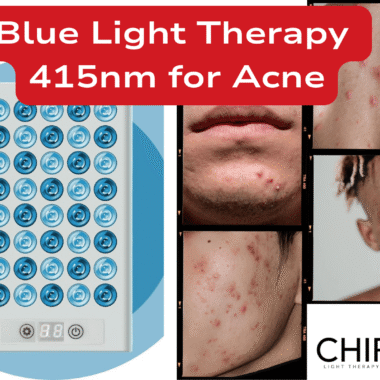
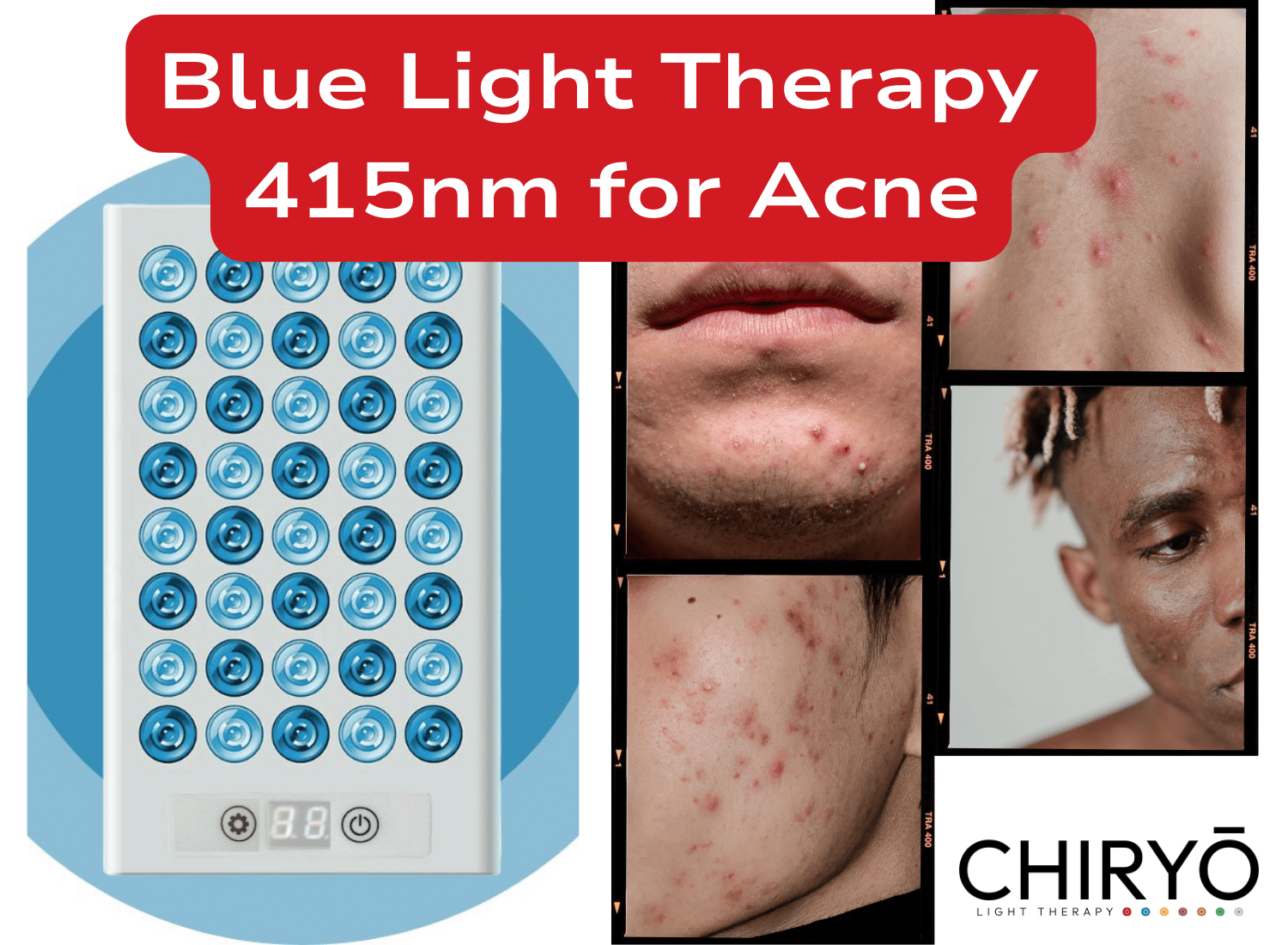
Blue Light Therapy 415nm supports clearer-looking, breakout-prone skin by targeting acne-causing bacteria and helping reduce active spots.
Within this short blog you’ll learn:
- What 415nm blue light
- Why it’s used for acne-focused light therapy
- How to use it safely and comfortably.
Blue Light Therapy 415nm Reduces Inflammatory Acne Lesions
415 nm LED monotherapy (open‑label study)
In a smaller open‑label study:
- Participants: 30 patients
- Acne Condition: Mild–moderate acne
- Blue Light Therapy Treatment: High‑intensity 415nm LED
- Frequency: Used twice weekly for eight weeks produced clear improvements
- Results: 9 out of 30 patients achieved complete clearing, with no serious side effects reported.
What this means in practice:
415 nm blue light is strongly supported as:
- A non‑drug option for mild to moderate inflammatory acne.
- A useful adjunct for people who cannot tolerate oral/topical drugs, or want to reduce antibiotic use.
Blue Light Therapy 415nm and Red Light Therapy 660nm Reduces Inflammatory Acne Lesions
415 nm is the classic “acne blue”, used in multiple clinical trials. It targets Cutibacterium acnes via porphyrins, generating reactive oxygen species (ROS) that kill the bacteria and reduce inflammation.
- 107‑patient randomised trial: 415 nm blue and 415 nm+660 nm blue–red both significantly reduced inflammatory acne lesions compared with control; blue–red gave the strongest effect, but blue‑only clearly improved acne.
- The mechanism is explained and used in commercial medical‑grade 415 nm acne systems.
Link: Phototherapy with blue (415 nm) and red (660 nm) light in acne vulgaris (Papageorgiou et al.)
https://pubmed.ncbi.nlm.nih.gov/10809858/
How 415 nm Blue Light Works
Wavelength depth and action:
415nm light penetrates only a few tenths of a millimetre into the skin, enough to reach sebaceous glands and the surface microbiome.
- This effect is called photodynamic inactivation (light‑activated bacterial destruction).
- Because the penetration depth of 415nm is shallow (mainly into the epidermis and upper dermis – the top skin layers), it focuses on surface bacteria and oil glands, not deep tissue.
- Blue Light Therapy 415nm is especially powerful against acne-causing bacteria called Cutibacterium acnes (formerly Propionibacterium acnes).
- When these bacteria absorb 415nm blue light, they produce reactive oxygen species (ROS), which destroy the bacterial cells without harming surrounding tissue. This process is called photodynamic inactivation.
Used with sensible dosing and proper devices, 415 nm is generally well tolerated, but marketing it as “only anti‑aging” would be misleading; its core strength is antibacterial control of acne, not collagen stimulation.
How to Use Blue Light Therapy Safely At-Home
Please follow the instructions of your specific device. Below are the common methods of applying blue light therapy at home:
- Cleanse the skin first to remove oil or makeup.
- Distance: Place LED mask onto your face, if using a blue light therapy panel keep your device around 10-15 cm from the skin.
- Session time: 10-20 minutes, 2-4 times per week for skin (higher irradiance devices may require a shorter treatment frequency/time).
- Avoid overuse: Blue light therapy is safe when used appropriately but may cause mild dryness or temporary redness if over-applied/sensitive skin.
- Eye protection: Always avoid direct eye exposure, especially with high-power LEDs.
Blue Light Therapy 415nm Antibacterial and skin-balance effects beyond acne
415nm Blue Light Therapy antibacterial effect is not limited to C. acnes.
Laboratory work has shown that blue light around this range can help inactivate other bacteria, including Staphylococcus aureus, which is often implicated in skin and wound infections.
However, for conditions like psoriasis, fungal infections or vaginal thrush, the evidence for Blue Light Therapy 415nm specifically is still experimental, mostly in vitro or animal models; there are not yet robust human clinical trials using 415nm as a stand‑alone treatment for these

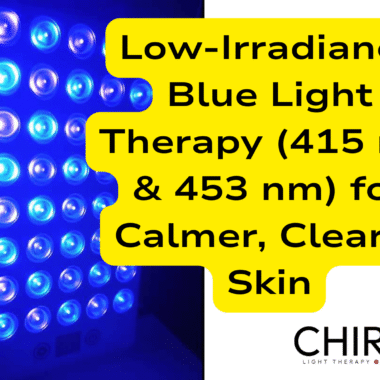
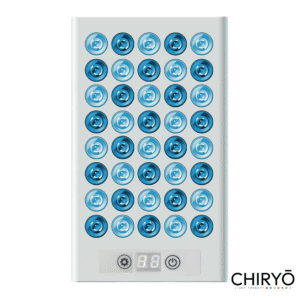
7in1 Blue Light Therapy Panel – 415nm & 453nm Skin Rejuvenation #1
Restore skin radiance with the CHIRYŌ Light Therapy 7in1 blue light therapy panel. This professional-grade panel uses a dual-action blue light approach to target surface impurities and promote a calmer, clearer complexion without harsh chemicals. Clearer Complexion: 415nm waves target blemish-causing factors for high-clarity skin. Oil & Pore Control: Helps normalise sebum production to reduce shine and visible pores. Soothing Effect: 453nm waves are tuned to minimise the appearance of surface redness.
Blue Light Therapy 415nm References:
- 415nm Blue Light Therapy for Acne (human trials):
- Randomized trial: blue (415 nm) vs blue+red (415 nm + 660 nm) for acne vulgaris (107 patients):
https://pubmed.ncbi.nlm.nih.gov/10809858/ - Open‑label 415 nm LED for acne (30 patients):
https://pubmed.ncbi.nlm.nih.gov/16581683/ - Clinical blue+red LED device (415 nm + 633 nm) for acne:
https://madrid.defelipe.com/wp-content/uploads/2020/11/Acne-Goldberg.pdf - 7‑week open‑label blue+red LED acne study (JCAD):
https://jcadonline.com/evaluating-the-efficacy-and-safety-of-phototherapy/
- Randomized trial: blue (415 nm) vs blue+red (415 nm + 660 nm) for acne vulgaris (107 patients):
- Broad dermatology overview of Blue Light Therapy LEDs (includes 415 nm):
- “Utilization of light‑emitting diodes for skin therapy” (review):
https://onlinelibrary.wiley.com/doi/10.1111/phpp.12841
- “Utilization of light‑emitting diodes for skin therapy” (review):
- Specific to 450–453 nm: Pigmentation and ROS in human skin:
- “Pigmentation effects of blue light irradiation on skin…” (450 nm / 453 nm‑range pigmentation and ROS study):
https://pmc.ncbi.nlm.nih.gov/articles/PMC7496068/ - “Highlighting nuances of blue light phototherapy…” (differences between 420 nm and 453 nm in pigmentation):
https://onlinelibrary.wiley.com/doi/full/10.1002/jbio.202200257
- “Pigmentation effects of blue light irradiation on skin…” (450 nm / 453 nm‑range pigmentation and ROS study):
Medical Disclaimer
This article is for general educational purposes only and is not medical advice, diagnosis, or treatment. Results may vary between individuals. Always consult your GP or qualified healthcare professional before using light therapy, especially if you have a medical condition, take prescription medication, are pregnant or breastfeeding, have epilepsy/seizure disorders, or experience light-triggered symptoms. Stop use immediately if symptoms worsen or you experience any unexpected reaction, and seek medical advice where appropriate.