Reading Time: 4-Minutes Author: Samantha Thompson
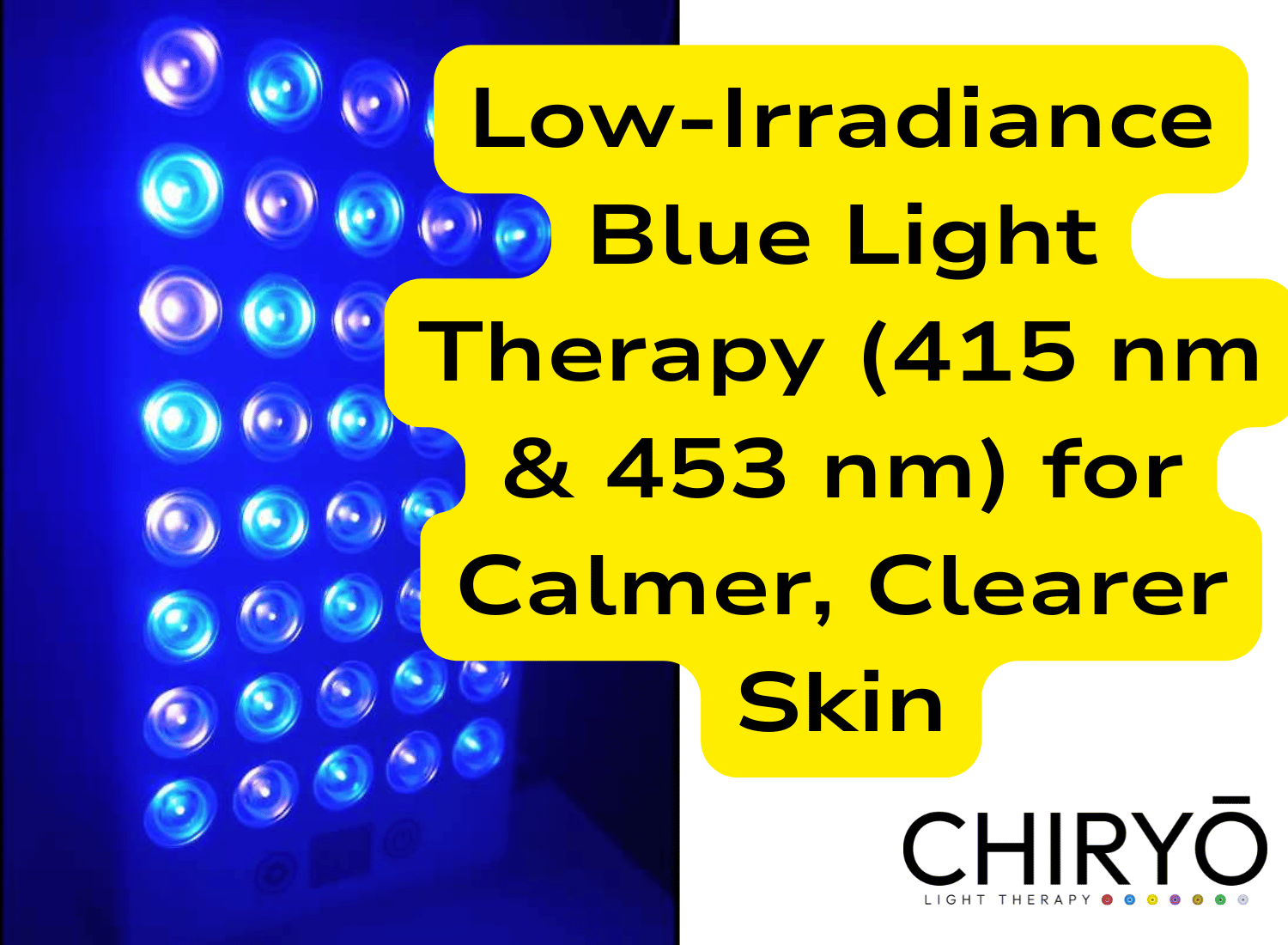
Blue light therapy at 415nm and 453nm can gently target skin bacteria and inflammation when delivered at low irradiance (10–35 mW/cm²), which helps balance potential skin improvements and benefits, whilst ensuring safety for regular use.
Blue Light Therapy 415nm
415nm blue light therapy for acne works by exciting porphyrins (light‑sensitive molecules) made by Cutibacterium acnes (acne bacteria), which leads to bacterial damage and fewer inflamed spots.
415nm wavelength also reaches into the upper dermis (upper skin layer) and can influence collagen‑rich structures, so low irradiance (gentle power density) becomes important to minimise long‑term photoaging risk while still providing an antibacterial effect.
- Clinical acne studies using 415nm or 415/660nm show meaningful reductions in inflammatory lesions and comedones (clogged pores) over 8–12 weeks, with good tolerability and no serious side‑effects reported.
- An “ooh interesting” point is that mixed blue‑red protocols often outperform blue light alone, suggesting 415nm may “clear the way” by reducing bacteria while red light supports anti‑inflammatory and repair pathways (healing processes).
Why Low Blue Light Therapy Irradiance matters (10–35 mW/cm²)
Low irradiance blue light therapy (low power per cm²) aims to stay in a “cell‑signalling” zone rather than a “cell‑stressing” zone, which is especially relevant for visible blue because of its stronger oxidative potential (tendency to create reactive oxygen species).
Experimental work in melanoma cell models (laboratory cancer cells) shows that higher irradiance blue light can strongly inhibit cell growth, with effects peaking around 19.84 mW/cm² in one setup, which is powerful but not necessarily what is wanted for routine home skin care.
- Photobiomodulation reviews emphasise that dose and irradiance together shape whether cells respond with beneficial signalling or with excessive oxidative stress (too many reactive oxygen species).
- For consumer‑facing blue light therapy devices, keeping blue irradiance roughly in the 10–35 mW/cm² range is an appealing middle ground: high enough for meaningful biological interaction, low enough to avoid unnecessarily aggressive exposures when sessions are repeated over months.
Blue Light Therapy 453nm Benefits
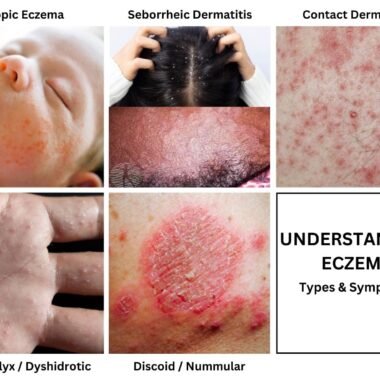
453nm blue light therapy for psoriasis and eczema appears to act more on keratinocytes (skin cells forming the outer barrier), and inflammatory immune cells than on acne bacteria, which makes it interesting for inflammatory dermatoses (inflammatory skin diseases).
- In a 2024 clinical trial, ten sessions of 453nm full‑body blue light led to statistically significant improvements in atopic dermatitis scores (EASI and SCORAD), with reduced itch and better quality‑of‑life metrics, and was well tolerated.
- A systems‑biology model (computer simulation of skin dynamics) reproducing clinical psoriasis data suggests that 453nm blue light reduces keratinocyte hyper‑proliferation (over‑growth), and supports their differentiation (maturation into stable barrier cells), which fits the observed thinning of thick psoriatic plaques after treatment.
Ooh, interesting: Blue Light Therapy 415nm vs 453nm
Blue light therapy 415nm vs 453nm appears to “specialise” in different skin targets, even though the colours look quite similar to the naked eye.
- 415nm aligns well with acne‑focused goals, where porphyrin‑mediated bacterial kill (light‑triggered bacterial damage) is desirable, but cautious dosing and low irradiance help reduce concerns about dermal collagen degradation and pigment issues over long‑term use.
- 453nm, by contrast, seems better at calming over‑active keratinocytes and local immune responses, so low‑irradiance protocols in the 10–35 mW/cm² window feel particularly well suited to chronic inflammatory conditions, such as atopic dermatitis and psoriasis that may need repeated, body‑wide exposure.
Practical Pointers for Blue Light Therapy Panels Low‑Irradiance Home-Use
Low irradiance blue light therapy at 415nm and 453nm can be integrated into skin routines at home, by pairing modest power densities with sensible session lengths and eye protection (barrier such as goggles for eyes).
- For panels or masks targeting 10–35 mW/cm², users typically adjust distance (how far from the LEDs) to “tune” irradiance, then keep sessions brief (often 5–15 minutes) to deliver a moderate total dose (overall energy per cm²).
- Another “ooh, interesting” insight is that blue light need not act alone: combining low‑dose 415nm/453nm sessions with subsequent red/NIR photobiomodulation may allow blue to handle microbial or hyper‑proliferative components while longer wavelengths support microcirculation (small blood vessel flow) and repair, creating a layered, multi‑wavelength strategy.
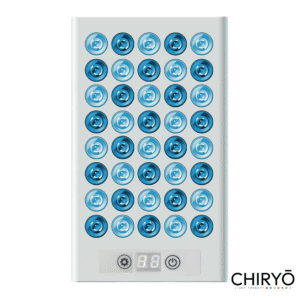
Blue Light Benefits 415nm + 453nm I Acne, Psoriasis, Eczema, Vitiligo, Rosacea, Redness, Bacteria
Transform your skin with the CHIRYŌ Light Therapy's 7in1 Skin Rejuvenation Panel #1. Expertly designed as a non-invasive treatment for stubborn skin conditions. This compact panel uses targeted wavelengths of 415nm and 453nm to effectively kill Acne, Bacteria, Psoriasis, Vitiligo, Eczema, Rosacea, and Redness, to produce a clearer complexion.
Clinical References for Blue Light Therapy 415nm and 453nm:
- Phototherapy with blue (415 nm) and red (660 nm) light in the treatment of acne vulgaris: https://pubmed.ncbi.nlm.nih.gov/10809858/
- Under the spotlight: mechanisms of photobiomodulation concentrating on blue and green light: https://pmc.ncbi.nlm.nih.gov/articles/PMC6685747/
- Irradiance plays a significant role in photobiomodulation of B16F10 melanoma cells: https://pmc.ncbi.nlm.nih.gov/articles/PMC6968738/
- Full-Body Blue Irradiation in the Treatment of Atopic Dermatitis: https://pubmed.ncbi.nlm.nih.gov/39180711/
- A Dynamic Model for Prediction of Psoriasis Management by Blue Light Irradiation: https://www.frontiersin.org/journals/physiology/articles/10.3389/fphys.2017.00028/full
- Light-emitting diode 415 nm in the treatment of inflammatory acne: https://pubmed.ncbi.nlm.nih.gov/16581683/
- Combination blue (415 nm) and red (633 nm): https://madrid.defelipe.com/wp-content/uploads/2020/11/Acne-Goldberg.pdf
This information is for general education only and is not medical advice, speak with a doctor or qualified health professional.